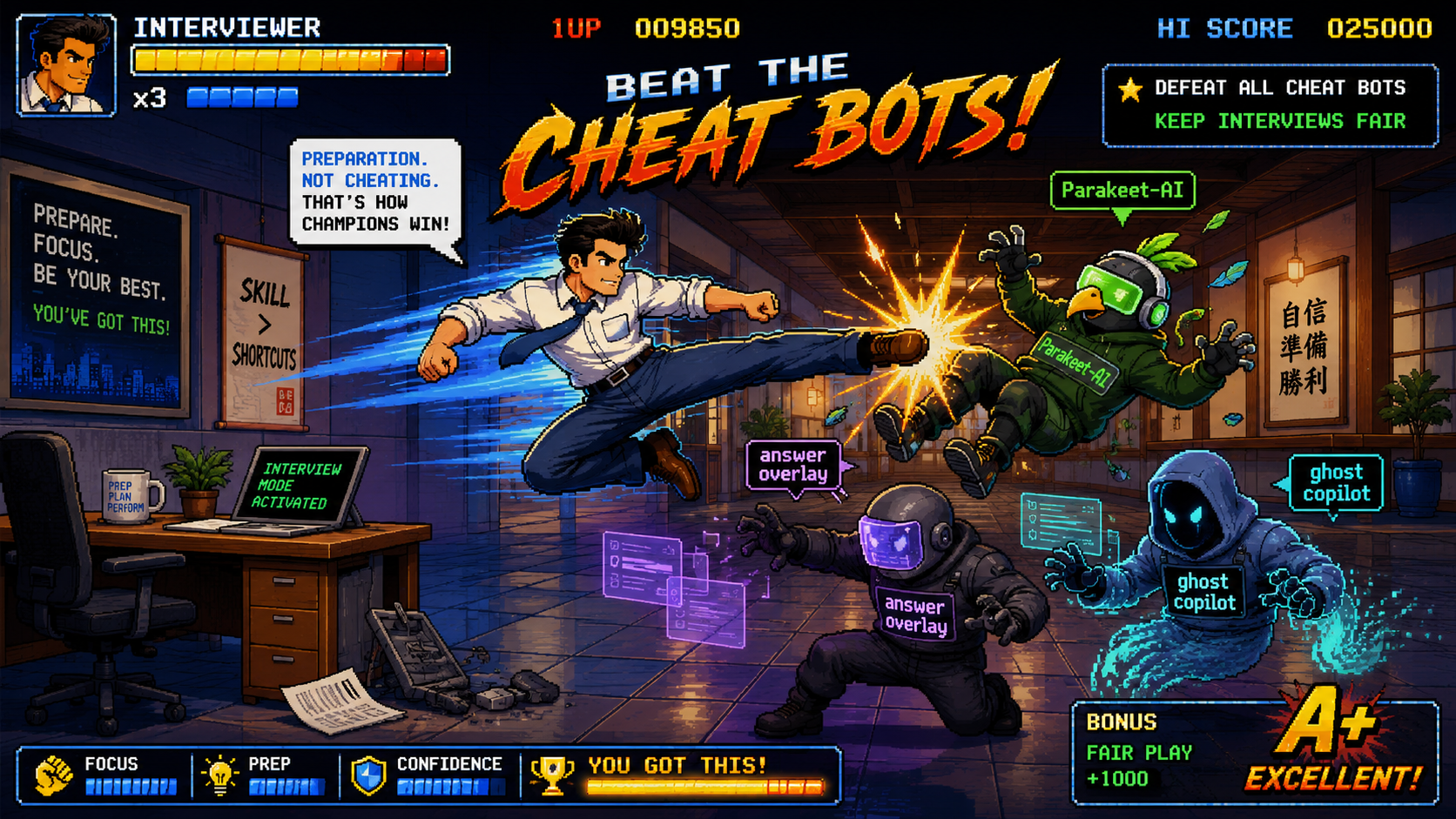
Tools like Parakeet AI, answer overlays, and ghost copilots are already in the room. Swiftly puts you on the right side of that fight.
Parakeet AI
Answer overlay
Ghost copilot
Tools like Parakeet AI and Cluely feed candidates real-time answers during technical interviews. Swiftly coaches you live — surfacing follow-up probes that reveal genuine depth, and catching inconsistencies before the call ends.
Start with one interview for ₹99 →₹99 to start · UPI, card & net banking · Works in your browser · No install
You're using Redis for sessions — what's your failover plan if the cluster goes down mid-interview?
Candidate hasn't addressed ephemeral vs. persistent trade-off.
Earlier you said you prefer minimal dependencies, but your stack has Redis, Kafka, and Elasticsearch. Help me understand that decision.
Conflicts with preference stated at 03:20.
You said this migration "definitely won't cause downtime." Walk me through your exact deployment steps for a 50M-row table.
Bold claim made without elaboration — tests whether the candidate built this or was briefed on it.
Tools like Parakeet AI, answer overlays, and ghost copilots are already in the room. Swiftly puts you on the right side of that fight.
Real example
A senior backend candidate is describing an architecture they've built. They're confident, fluent, detailed. Swiftly catches something that would be easy to miss under time pressure.
We started simple — a monolith with a single shared Postgres instance, then split things out gradually as the team grew.
We went microservices from day one. Each service owns its own database, no shared schemas. Kafka for async communication between them.
And data consistency across services?
Saga patterns with compensating transactions. Works really well — zero data inconsistency issues in production.
Earlier you said you started with a shared Postgres monolith, but just now you said microservices from day one. Which was it — and how did you manage the migration between the two?
Conflict between 03:14 and 11:58. A fluent answer suggests real experience; a vague one suggests the architecture was described to them, not built by them.
The new reality
A growing category of tools — Parakeet AI, Cluely, Interview Coder, Final Round AI — listens to interview audio in real time and feeds candidates polished answers through a hidden overlay. The candidate sounds sharp. The signal is noise.
Detection is structurally weak: OS exclusion APIs make overlays invisible to screen-share, hidden second devices evade all in-meeting controls. The arms race is already lost.
The best interviewers stopped playing defence. They conduct interviews where AI assistance simply doesn't help — because the questions that matter can't be answered without the experience behind them.
Swiftly uses your microphone to transcribe the interview in real time via Sarvam AI's speech engine — optimised for Indian-accented English. No bot joins the call. No recording is stored. Audio is discarded after each transcription chunk.
Every 60 words, Swiftly analyses the transcript and generates a follow-up question targeting depth gaps, vague claims, and things the candidate hasn't fully backed up. The questions it suggests can't be answered by a copilot that only heard the last few seconds.
Swiftly tracks what the candidate says throughout the call. When a later statement contradicts an earlier claim, it surfaces the conflict with a timestamp — so you can press on it before the call ends, while the candidate is still live.
Common questions
Before your first interview, the answers to what most engineering managers ask us.
No. Swiftly runs in a browser tab on your device only. The candidate sees your face on the call; there's no bot join notification, no change to the meeting, and no indication anything else is running. It's your tool, on your screen.
Yes. As the interviewer, you are a party to the conversation — so using a tool that helps you listen more carefully is no different from taking notes. Swiftly does not record or retain audio; it discards each chunk immediately after transcription. If your company has specific policies on AI-assisted tooling, check those first.
Discarded immediately after each transcription chunk. Nothing is retained on Swiftly's servers — not the audio, not the raw transcript. The only data that persists is the coaching output (the probes and flags) which lives in your browser session.
Yes. Swiftly uses your device's microphone directly — it works alongside any meeting platform, on any operating system. No integration or plugin required. Run your call in one window and Swiftly in another on your phone or laptop.
Free trials attract zero-intent signups. Swiftly is built for interviewers who run 4+ sessions a week and need it to work every time. The ₹99 Intro Pack covers one full session at near our cost — enough to decide if it's worth it.
Works in your browser on any device. Start with one interview for ₹99. Built for engineering teams who care about getting the hire right.
₹99 to start · UPI & card · Audio never stored